
Computershare announced this month that US listed companies can now issue their shares in tokenized form. Computershare keeps the records for more than half the S&P 500. The mechanic is that an issuer can mint Issuer Sponsored Tokens that sit alongside the certificates already held in the Direct Registration System, with Computershare acting as transfer agent for both. The token is the legal share, with the same registry, the same issuer, and the same corporate actions. It is the share, expressed onchain.
Once tokenized US equities can sit at the same address as tokenized US Treasuries, tokenized money market funds, tokenized private credit, stablecoin balances, and bitcoin, the question of what an “account” is really starts to fall apart. Or I suppose more precisely, the question of where the customer relationship lives starts to fall apart.
I think there’s a bit of a vocabulary problem in tokenized finance, and it tells you almost everything about who is best positioned for what is coming. Bankers and fintech operators say “account.” They mean a balance with a name on it, a card attached, a statement, KYC, send and receive across rails, an entry in a ledger somewhere. Crypto native builders say “wallet.” They mean an address, a set of keys, control over assets onchain. Both groups think they are talking about roughly the same object dressed up in different clothes. They’re really not.
The vocabulary diverged because the worlds did. Banks issued accounts because banks held one type of asset, cash deposits. Brokers issued accounts because they held another, securities. Fund custodians issued accounts because they held another, fund interests. The architecture of retail finance was always a set of single asset institutions, each with its own account primitive, each organized around the asset class it was licensed to hold. The “account” was never an abstraction over assets. It was a ledger entry inside a specific institution that could only hold the specific thing that institution was allowed to hold.
The wallet was different from the start. Bitcoin had no banking layer. Ethereum had no banking layer. The wallet was not a slice of an institution’s ledger, it was an address that held whatever could be expressed onchain. From the inside, that looked like a primitive. From the outside, to bankers, it looked more like a toy.
It was not a toy. Actually I think about it as the bundle.
The Merrill precedent
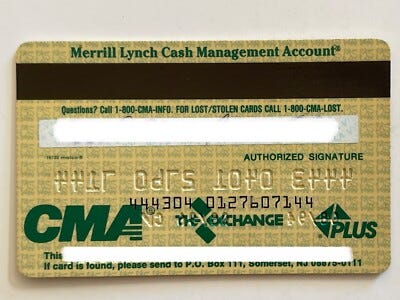
In 1977, Merrill Lynch introduced the Cash Management Account. The CMA combined a brokerage account, a money market fund sweep, check writing, and a Visa card. The cash from your trading account did not sit idle, it swept overnight into a money fund earning market rates. You could write a check against the money fund balance. You could spend on the card and you could buy and sell securities. One statement, one provider, one consolidated view of the customer.
Banks at the time were furious. Through the late 1970s and early 1980s, they sued, lobbied, and ran campaigns to stop the CMA on the grounds that Merrill was effectively a bank operating without a banking license. They lost. By 1981, four years after launch, Merrill had 300,000 CMA customers. By the mid 80s, more than a million. The reason banks were angry was not that Merrill had built a better product. It was that Merrill had bundled four previously separate institutional relationships into one, and the bundle was a different kind of object from anything banks were licensed to build.
Money funds in the late 1970s grew because Regulation Q capped what banks could pay on deposits while inflation ran above the cap. That meant the deposits left. Merrill’s innovation was not the money fund itself, it was wrapping the money fund inside an account that also did checking, lending, and securities, so that the customer never had to leave the broker for any reason.
That is probably the optimistic reading of the precedent. I think the honest reading is really interesting.
Why the CMA stalled
The CMA succeeded as a product and failed at consolidation. The product became a category every broker copied. But the customer relationship did not actually migrate away from banks. Most CMA holders kept their checking account at a bank. The bundle captured the affluent investor’s cash and securities slice. It did not capture the customer’s financial life. Three things stalled it.
The first was that the regulatory arbitrage closed. The CMA was substantially powered by Regulation Q, which capped what banks could pay on deposits while inflation ran above the cap. The Depository Institutions Deregulation and Monetary Control Act of 1980 began the phaseout, and by 1986 the cap was gone. Once banks could pay market rates, the asset drain Merrill was exploiting largely stopped. The bundle’s pull weakened in lockstep with the spread.
The second was that Glass-Steagall capped the bundle. Merrill could not actually offer a deposit account. The “checking” inside the CMA was check writing against a money fund. The card was issued by a partner bank. The credit was margin against securities. So Merrill never held the customer’s primary bank relationship in any chartered sense. The bundle was operationally incomplete because the regulatory perimeter did not let one institution hold cash, securities, and credit at the same time.
The third was cost structure. The CMA’s operational economics required affluent balances, with a $20,000 minimum at launch. The bundle never really became a mass market financial container, because the unit economics of running brokerage operations, money fund servicing, check clearing, and card processing for a single customer did not work below a certain balance. Banks kept the mass market by default.
Then banks counter bundled. Through the 1980s and 1990s they built their own brokerage and money fund products, and by the time Glass-Steagall was repealed in 1999 the bank built bundle was close enough that the broker built bundle had lost its decisive advantage. Schwab and Fidelity competed Merrill down. The customer relationship redistributed across institutions rather than consolidating into one. The bundle settled into a category, and not a winner.
So you might conclude from the CMA precedent that the bundle is real, but it stalls when the structural arbitrage driving it closes, when the regulatory perimeter stops a single operator from holding the full asset stack, and when the cost structure forces the bundle to stay premium. Three constraints. I think it’s worth holding each one up against the wallet to see whether it binds the same way.
Why the wallet is not the CMA
The wallet does not depend on regulatory arbitrage. Its advantages, treasury optimization across asset classes, multi asset collateralization, native data on the customer’s full balance sheet, scoped delegation to autonomous agents, are structural and technology driven. They do not turn on a yield spread that can close. They do not weaken when interest rate regimes shift or when stablecoin yield rules tighten or loosen. The CMA’s pull was substantially a Reg Q artifact. The wallet’s pull is not an artifact of any single regulation.
The wallet has no Glass-Steagall problem. The wallet operator does not need to hold the assets in the chartered sense. The token is the legal share, the legal Treasury claim, the legal money fund interest, with the issuer and the transfer agent and the custodian of record sitting where the law requires them to sit. The wallet operator holds the keys, routes the flows, and serves the customer. The legal perimeter follows the asset, not the operator. There is no equivalent to the wall that prevented Merrill from holding deposits.
The wallet’s cost structure runs on shared infrastructure. The chains, the settlement, the smart contract logic that holds the assets are not paid for per customer by the wallet operator. The marginal cost of adding a customer is closer to zero than to the per account operational cost of running a brokerage. The premium only constraint that kept the CMA an affluent product does not apply here.
What does carry over from the CMA story is the counter bundling risk. Banks counter bundled Merrill, and they will try to counter bundle the wallet. The question is whether they can? To counter Merrill, banks had to build a brokerage division and a money fund. To counter the wallet, they have to stand up a multi asset, programmable, agent ready container that holds tokenized everything across jurisdictions on shared infrastructure. That feels like it’s a much bigger transformation than spinning up a brokerage. Some banks will get there. A lot will not. Which banks land where is the really the question, and I think it’s an institutional design question more than a technology one.
What the wallet absorbs
This is where the numbers start to matter. Stablecoin float crossed $320 billion in May 2026. Tokenized real world asset value hit $26.4 billion in March, up from $6.6 billion a year earlier, roughly four times the prior year. BlackRock’s BUIDL, the tokenized Treasury fund, sits at around $2.85 billion and accounts for roughly forty percent of the tokenized Treasury market, which itself has crossed $5 billion. The Computershare and Securitize agreement opens a structural pathway for the roughly $70 trillion of US listed equity to issue directly onchain. Six asset categories have each crossed the $1 billion mark: private credit, commodities, US Treasuries, corporate bonds, non-US sovereign debt, and institutional alternative funds.
None of those numbers individually look big in the context of US household financial assets, which run somewhere north of $120 trillion. The point is the trajectory of what fits inside a single address. A year ago, a wallet held stablecoins and a few experimental Treasury tokens. Today it can hold short dated Treasuries, money market interests, private credit positions, gold, corporate debt, bitcoin, and, pending the Computershare flow scaling, public equities. The asset categories that previously required separate institutional relationships are arriving into the same container, one after another.
This is what makes the wallet the bundle. Not the token standard. Not the chain. The fact that the container is asset agnostic in a way that no banking, brokerage, or custody account has ever been.
The economic gravity of the bundle
Once you hold a customer’s full balance sheet in one place, four things change in the operator’s favor, and I think they all compound.
The first is treasury optimization. If a customer’s idle dollars and their tokenized money market fund holdings live at the same address with sub second conversion between them, there is no reason for cash to sit idle. Whoever owns the wallet can offer auto routing, where cash sweeps into the highest yielding tokenized money market fund the customer’s profile permits, and routes back to spendable balance the moment a payment is initiated. This is not a premium service. It is a default feature that makes idle cash an unforced error. The yield debate currently consuming the regulatory conversation around stablecoins becomes structurally less interesting once treasury automation is one click below the surface, because the spendable balance does not have to pay yield if the wallet’s other holdings do.
The second is collateralized lending. When a customer’s cash, Treasuries, equities, private credit, and bitcoin all live in one address, lending against the consolidated balance sheet becomes one underwriting decision instead of five. Margin calls become a programmatic operation against the wallet rather than a phone call to a different institution. The credit product the wallet operator can offer is structurally better than what any single asset incumbent can offer, because the single asset incumbent only ever sees a single asset.
The third is data. Whoever holds the wallet sees the customer’s full financial life: what they hold, what they earn, what they spend, what they save, what they trade. That is the dataset banks have been trying to assemble for forty years through aggregation, account to account data sharing, and open banking mandates. The wallet operator gets it natively, not because of a regulatory regime, but because the data is structurally co-located with the assets.
The fourth is that agents need wallets, not accounts. An autonomous agent that can pay an invoice, rebalance treasury, settle a trade, and move funds across rails needs scoped access to a portfolio, not a checking balance. The wallet is the natural surface for delegation because it is the surface that has the assets. The “account” is a thin slice of one asset class. Useful for cards and rails. Useless as the primary delegation surface for anything more sophisticated.
Where the platforms are pointed wrong
Most of the platform level conversation right now is still pointed at the account. Marketplaces want to issue their users a dollar account. Creator platforms want to issue their creators a dollar account with a card. Remittance companies want to give their recipients a dollar account they can spend from. Each of these is a real improvement over the status quo, where the platform pays out to an edge bank in another country and loses the customer relationship the moment the cash lands. None of them are the actual prize.
The actual prize is issuing the user a wallet. The dollar balance is one of the assets that wallet holds. The platform that issues a wallet is, eventually, holding the user’s tokenized treasuries, their tokenized money fund position, their bitcoin savings pocket, their tokenized share of the platform’s own equity if the platform is public, and the spendable dollar balance that pays for things in the meantime. The platform that issues a dollar account is holding only the spendable balance, which is the fraction of the customer’s financial life with the lowest yield, the lowest stickiness, and the most competition.
I think this is the move most platforms are not going to make in time. Issuing a wallet is a bigger commitment than issuing an account. It implies standing up custody operations, asset class specific compliance, surveillance, governance over the smart contracts that hold the assets, and a customer support function that can answer questions about more than dollars. It implies hiring people who understand securities operations, not just payments. It implies being a balance sheet relationship, not a payments endpoint.
The platforms that get there first will look like Merrill Lynch in 1981. The platforms that do not will look like the regional banks that watched 300,000 customers walk out the door and decided the problem was probably regulatory.
Different kind of institution
A bank competing to be the wallet operator is not competing to be a bigger bank. It is competing to be a different kind of institution. The economics per asset class are smaller than holding the assets directly, but the relationship spans every asset class, which is the trade incumbents have not had on offer before. Most of them are not currently set up to take it. Their internal systems, their compliance organizations, and their product teams are organized around single-asset operations. The wallet is multi asset by definition. The pivot is closer to what cloud migration was for IT departments than to anything in the recent banking playbook, except with charters and capital requirements wrapped around it.
The vocabulary tells you who is serious
When a banker walks into a tokenization conversation and starts asking which “account” the customer holds, what they are revealing is not a translation issue. They are still operating inside a frame where one institution holds one asset class on behalf of the customer. When a crypto native builder treats the wallet as a primitive that the customer manages alone, what they are revealing is that they have not yet thought about who serves the customer when the wallet contains a tokenized share of Apple, a tranche of private credit, and a money market position. Both vocabularies are partial, and the institutions that figure this out first are the ones already trying to bridge the two.
The signs are visible across several institutions building wallet infrastructure with the operational discipline of a custodian and the compliance perimeter of a broker, absorbing each new asset class as it tokenizes. Computershare and Securitize, opening the path for tokenized US equities. BlackRock’s BUIDL extending across multiple chains. State Street’s tokenized fund servicing. Coinbase Prime’s institutional flows. The remittance and creator platforms experimenting with branded dollar accounts are an early, incomplete version of the same instinct.
None of these institutions are calling what they are building “the wallet.” Most are still calling it an account, or a custody product, or a tokenization platform. The naming is lagging the architecture, which is normal. Merrill did not call the CMA “the bundle” either. It called it a cash management account, and it took the banks half a decade to figure out what they were actually losing.
The account is not going away. It is being absorbed. The product the customer sees may still have a name like “global account” or “checking account” or “treasury account.” Underneath it will be a wallet that holds the spendable balance and everything else. The institution that operates that wallet holds the customer relationship. The name on the front door is a marketing question. The name on the keys is a structural one.
The wallet is the new bundle. The institutions that understand that are building the infrastructure for it. The institutions that do not are competing for the spendable slice of a balance sheet they no longer get to see.
References
Securitize, Computershare open path for $70 trillion in U.S. stocks to move onchain (CoinDesk)
Tokenized Real-World Asset Value Jumps Fourfold to $26 Billion (PYMNTS, 2026)
BlackRock BUIDL Tokenized Treasury Fund Hits $2B AUM (Blocklr, 2026)
BlackRock USD Institutional Digital Liquidity Fund (Securitize)
Stablecoin Liquidity Hits $320.6B Milestone in May 2026 (KuCoin)
75 Years of Innovation: Cash Management Account (SRI International)
Dividends: Battle over the CMA Clones (TIME magazine archive)
US Federal Reserve Z.1 Financial Accounts of the United States